For copy-paste compatibility with Python, reaborn provides a sns.-prefixed
alias for every public plotting, palette, and theming function (R allows dots
in identifiers). So pasted seaborn code such as
sns.scatterplot(data = df, x = "a", y = "b", hue = "g") runs verbatim.
Each alias is identical to its unprefixed counterpart; see that function for
arguments and details.
Value
Each sns.-prefixed object is the exact same function as its unprefixed
counterpart (sns.scatterplot <- scatterplot, and so on), so calling an
alias returns precisely what the counterpart returns. By category: the
plotting functions (e.g. sns.scatterplot(), sns.histplot(),
sns.heatmap(), sns.pairplot(), sns.FacetGrid(), sns.palplot()) return
a reaborn_plot object (a ggplot2/patchwork object that draws when printed),
except the easter-egg sns.dogplot(), which prints an affirmation and
returns NULL invisibly;
the palette constructors (e.g. sns.color_palette(), sns.husl_palette(),
sns.cubehelix_palette()) return a character vector of hex colors, or a
reaborn_cmap; the color helpers sns.desaturate(), sns.saturate(), and
sns.set_hls_values() return a hex color string; sns.axes_style() and
sns.plotting_context() return a named list of style/context parameters;
sns.despine() and sns.move_legend() return a ggplot2 theme object to add
to a plot; sns.load_dataset() returns a data frame and
sns.get_dataset_names() a character vector; and the theming setters
(sns.set_theme(), sns.set(), sns.set_style(), sns.set_context(),
sns.set_palette(), sns.set_color_codes(), sns.reset_defaults(),
sns.reset_orig()) are called for their side effect of changing global plot
defaults and return their value invisibly. See each unprefixed function's own
help page for the precise structure and meaning of its return value.
Examples
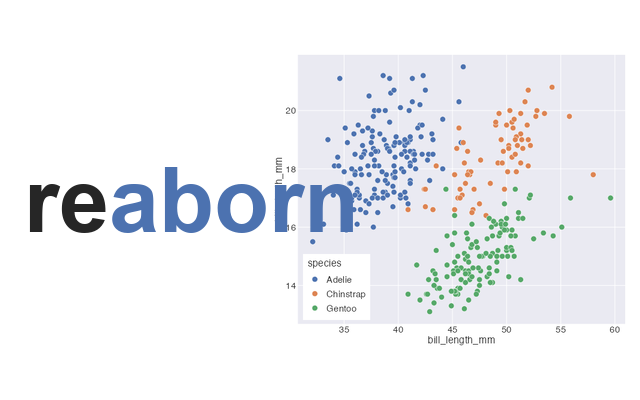
pen <- load_dataset("penguins")
p <- sns.scatterplot(data = pen, x = "bill_length_mm", y = "bill_depth_mm",
                     hue = "species")